
Structuring an Effective EOFY Destruction Plan


Build a compliant document destruction framework that protects your business and satisfies Australian regulations.
What You Must Know
Australian law requires retaining tax records for 5 years and employment records for 7 years. Premature destruction risks penalties; excessive retention creates security exposure.Why This Matters
A structured destruction plan ensures regulatory compliance, protects against data breaches averaging $4.26 million in costs, and frees valuable storage space.Critical Warning
Never destroy documents subject to litigation, audits, or investigations regardless of retention periods. Implement legal holds immediately when disputes arise.
Every financial year-end, Australian businesses face the same challenge: which documents to keep and which to destroy. Get it wrong, and you're looking at penalties up to $50 million or exposing sensitive data to breaches. This guide walks you through building a destruction plan that satisfies legal requirements while eliminating security vulnerabilities.
Why an End-of-Financial-Year Destruction Plan is Critical for Australian Businesses
An effective EOFY destruction plan protects your business from data breaches, ensures regulatory compliance, and frees up valuable storage space.
Every year, Australian businesses accumulate thousands of documents containing sensitive information-from employee records and financial statements to client data and contracts. Without a structured approach to destroying these documents at financial year-end, you expose your organisation to significant security risks, potential legal penalties, and operational inefficiencies.
Compliance Warning
Australian Privacy Act 1988 requires reasonable steps to protect and destroy personal information when no longer needed
The Australian Privacy Act 1988 requires entities to take reasonable steps to protect personal information they hold from misuse, interference, loss, and unauthorised access, modification or disclosure. It also includes guidance on the reasonable steps entities are required to take to destroy or de-identify personal information that they hold once it is no longer needed (unless an exception applies).
Non-compliance can result in fines up to $50 million for serious or repeated breaches, or 30 percent of the company’s adjusted turnover in the relevant period, whichever is greater. Beyond legal obligations, document accumulation creates physical clutter, increases storage costs, and complicates information retrieval when you actually need specific records.
A well-structured EOFY destruction plan addresses three core business needs: compliance with retention requirements, protection against data breaches, and operational efficiency. This systematic approach ensures you destroy documents at the right time-neither too early (risking non-compliance with statutory retention periods) nor too late (accumulating unnecessary security vulnerabilities).
IBM’s annual Cost of a Data Breach Report reveals that the average cost of a data breach in Australia has reached a record high of $4.26 million in 2024, reflecting a 27% increase since 2020.
Your destruction plan must balance competing priorities: maintaining records long enough to satisfy legal requirements while eliminating them promptly enough to minimize security exposure. The following sections will guide you through building a comprehensive destruction framework that protects your business while streamlining your document management processes.
Conducting a Comprehensive Document Audit Before EOFY
Before you can destroy documents effectively, you need a complete inventory of what you’re holding, where it’s stored, and how long you must retain it.
A thorough document audit forms the foundation of your destruction plan and prevents the catastrophic mistake of destroying records you’re legally required to keep.
Identifying All Document Categories and Storage Locations
Start by mapping every location where your business stores physical and digital documents. This includes filing cabinets, storage rooms, off-site archives, employee desks, and digital servers. Many businesses discover documents in unexpected places during audits-forgotten boxes in basements, old files on retired computers, or papers stashed in personal workspaces.
Create a master list categorizing documents by type and function:
- Financial records: Tax returns, invoices, receipts, bank statements, payroll records, superannuation documents
- Employee files: Employment contracts, performance reviews, disciplinary records, leave applications, workplace injury reports
- Client and customer data: Contracts, correspondence, transaction records, credit applications, marketing preferences
- Corporate governance: Board minutes, shareholder records, company formation documents, policy manuals
- Operational documents: Supplier agreements, insurance policies, property leases, equipment warranties
Assign responsibility for each category to specific team members. Your finance manager should audit financial records, HR should review employee files, and department heads should inventory their respective operational documents. This distributed approach ensures nothing gets overlooked and leverages subject-matter expertise.
Determining Legal Retention Requirements by Document Type
Australian law imposes specific retention periods that vary dramatically by document type and industry. Destroying records prematurely can result in penalties, while over-retention creates unnecessary risk exposure.
Standard Australian retention periods include:
| Document Type | Minimum Retention Period | Governing Legislation |
|---|---|---|
| Tax records (income, deductions, credits) | 5 years | Income Tax Assessment Act 1997 |
| Employment records (wages, super, leave) | 7 years | Fair Work Act 2009 |
| Company financial reports | 7 years | Corporations Act 2001 |
| GST records | 5 years | A New Tax System (GST) Act 1999 |
| Contracts and agreements | 7 years after expiry | Various state limitation acts |
Industry-specific requirements may extend these periods. Healthcare providers must retain patient records for 7 years after last treatment (or until a minor patient turns 25). Financial services firms face retention periods of 7 years for most client records under ASIC regulations. Legal practices must retain trust account records for 7 years under state legal profession acts.
Critical warning: Destroying documents subject to ongoing litigation, investigations, or audits-regardless of retention periods-can result in obstruction charges and severe penalties.
Creating an Inventory System for Tracking Document Ages
Without a reliable tracking system, you cannot confidently determine which documents have reached the end of their retention period. Implement a dating and categorization system that makes destruction decisions straightforward when EOFY arrives.
For physical documents, establish a consistent filing methodology:
Date-based filing: Label boxes and folders with creation dates or retention expiry dates. For example, “Supplier Invoices 2019 – Destroy After June 2026” provides immediate clarity. Use colour-coded labels for different retention periods-red for 5 years, blue for 7 years, green for permanent retention.
Centralized logging: Maintain a digital spreadsheet or document management system that records document categories, quantities, storage locations, creation dates, and destruction eligibility dates. This master log becomes your destruction checklist each year.
Regular updates: Assign someone to update the inventory quarterly as new documents are created and old ones are destroyed. An outdated inventory defeats the purpose of systematic tracking and can lead to premature destruction or excessive retention.
For digital documents, leverage metadata and file naming conventions. Include dates in filenames (e.g., “2019_Annual_Report.pdf”) and use folder structures that separate documents by retention category. Many document management systems can automatically flag files for review or destruction based on creation dates and retention rules you configure.
Establishing Clear Retention Policies and Destruction Schedules
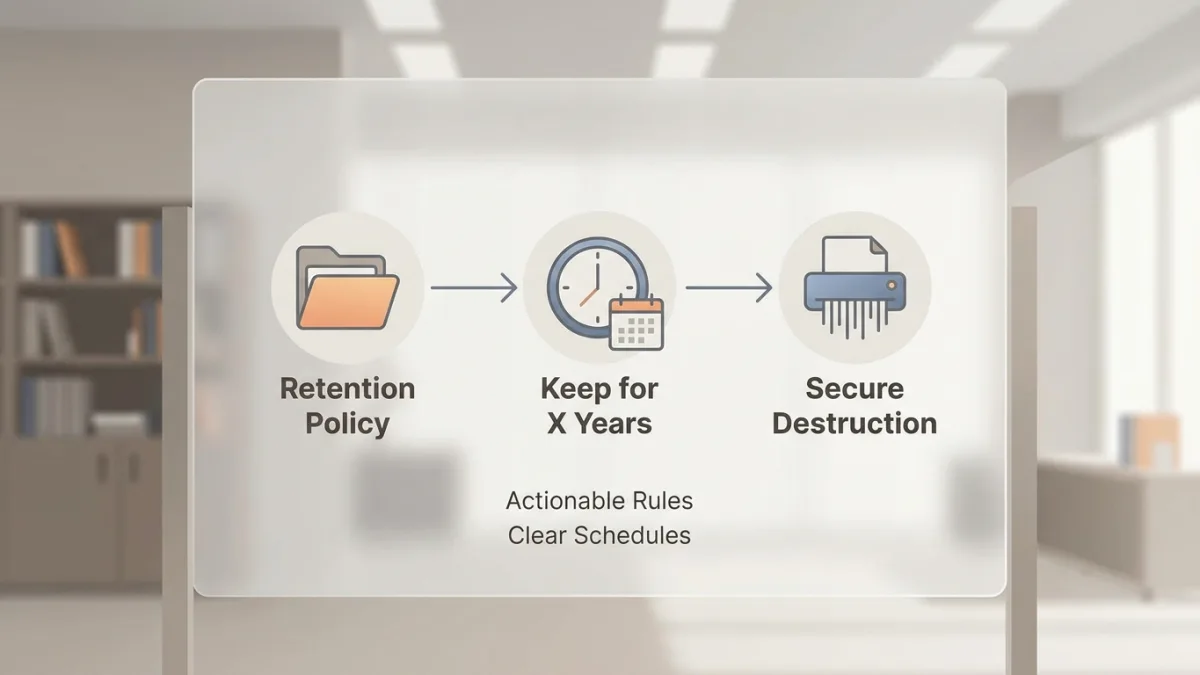
A document retention policy transforms your audit findings into actionable rules that govern what you keep, for how long, and when you destroy it.
This policy serves as your organization’s authoritative reference, ensuring consistent decision-making across all departments and protecting you from both premature destruction and excessive retention.
Core Business Needs
3 priorities- 1 Compliance with retention requirements
- 3 Operational efficiency improvements
Developing a Written Retention Policy Aligned with Regulations
Your retention policy must be documented, approved by senior management, and communicated to all employees who handle sensitive documents. A verbal understanding or informal practice provides no legal protection and creates inconsistency across your organization.
Essential components of a comprehensive retention policy:
Policy scope and purpose: Clearly state that the policy applies to all business records in any format (paper, digital, audio, video) and explain its dual purpose-compliance with legal requirements and protection of business interests.
Retention schedule by category: List each document category with its specific retention period and the legal basis for that timeframe. This schedule should directly reference the governing legislation (e.g., “Employee wage records: 7 years from creation, per Fair Work Act 2009, Section 535”).
Exceptions and holds: Define circumstances that suspend normal destruction schedules, including active litigation, government investigations, audits, or disputes. Establish a “legal hold” process that temporarily prevents destruction when these situations arise.
Roles and responsibilities: Designate who is responsible for implementing the policy (typically a Records Manager or Compliance Officer), who approves destruction activities, and what each department’s obligations are for compliance.
Review and update procedures: Commit to reviewing the policy annually to incorporate regulatory changes, new document types, or lessons learned from implementation challenges.
Obtain board or executive approval for your retention policy. This endorsement demonstrates organizational commitment and provides legal protection by showing you’ve implemented reasonable safeguards in good faith.
Creating Department-Specific Destruction Timelines
While your master retention policy establishes organization-wide rules, each department needs a practical timeline that translates these rules into specific EOFY actions. Department-specific timelines account for the unique document types each area generates and the varying retention periods they must observe.
Finance department EOFY destruction timeline:
- May: Identify all financial records reaching 5-year retention (created in 2021 or earlier) and 7-year retention (created in 2019 or earlier)
- Early June: Verify no records are subject to ongoing audits or disputes
- Late June: Obtain destruction approval from CFO
- July: Execute destruction and document completion
Human Resources EOFY destruction timeline:
- April-May: Review terminated employee files reaching 7-year post-termination retention
- May: Audit recruitment files for candidates not hired (typically 12-month retention)
- June: Separate permanent retention items (workplace injuries, discrimination complaints) from eligible destruction items
- July: Destroy approved employee records
Sales and Marketing EOFY destruction timeline:
- May: Review client files for inactive accounts exceeding retention periods
- May-June: Verify compliance with Australian Privacy Principles for customer data destruction
- June: Update CRM systems to reflect customer data deletion
- July: Destroy physical customer files and securely delete digital records
Coordinate these departmental timelines to avoid overwhelming your destruction resources (whether in-house shredders or external service providers) and to ensure adequate oversight of the destruction process.
Building Flexibility for Litigation Holds and Special Circumstances
Even the most comprehensive retention policy must accommodate unexpected situations that require deviating from standard destruction schedules. A rigid policy that doesn’t account for litigation, investigations, or business-critical circumstances can expose your organization to serious legal consequences.
Litigation hold procedures are your most critical exception mechanism. When your organization becomes involved in litigation or reasonably anticipates litigation, you must immediately suspend destruction of all potentially relevant documents-regardless of their scheduled destruction date. This includes:
- Issuing written “legal hold” notices to all custodians of potentially relevant documents
- Identifying and securing all documents related to the matter, including emails, text messages, and digital files
- Suspending automatic deletion processes in email systems and document management platforms
- Maintaining the hold until legal counsel confirms the matter is fully resolved
Investigation and audit accommodations require similar preservation. When government agencies request records or conduct investigations, preserve all potentially relevant materials until the investigation concludes and any appeal periods expire. This applies to tax audits, workplace safety investigations, privacy complaints, and regulatory inquiries.
Implement a “when in doubt, preserve it” principle. The cost of retaining documents during uncertain periods is negligible compared to the penalties for destroying records relevant to legal proceedings.
Business-critical exceptions may justify retaining documents beyond minimum legal requirements. For example, you might retain certain client project files longer than required to defend against potential future claims, or preserve strategic planning documents for institutional knowledge purposes. Document these business-driven retention extensions in your policy and review them periodically to ensure they remain justified.
Selecting Secure and Compliant Destruction Methods
The method you choose for destroying documents directly impacts your security, compliance status, and environmental footprint.
Personal information is destroyed when it can no longer be retrieved. The steps that are reasonable for an organisation to take to destroy personal information will depend on whether the personal information is held in hard copy or electronic form.
Map Locations
Identify all storage locations
Categorize Documents
Create master list by type
Assign Responsibility
Delegate to team members
Track Ages
Implement inventory system
Comparing On-Site vs Off-Site Shredding Services
Both on-site and off-site shredding provide secure destruction when executed properly, but they suit different business needs, volumes, and security requirements.
On-site shredding brings industrial shredding equipment to your premises, where documents are destroyed while you observe. A mobile shredding truck equipped with commercial shredders processes your documents immediately, typically converting them to confetti-cut particles in minutes.
Advantages of on-site destruction:
- Visual verification: You witness the destruction process, providing maximum assurance that documents are actually destroyed rather than just removed from your premises
- Minimal chain of custody: Documents never leave your secure environment, reducing opportunities for interception or loss
- Immediate completion: Destruction happens during the service visit, eliminating the waiting period associated with off-site processing
- Reduced internal handling: Documents can often be shredded in their original boxes or bins without extensive sorting
Limitations of on-site services:
- Volume constraints: Mobile shredders have capacity limits; extremely large volumes may require multiple visits or off-site processing
- Higher per-unit costs: On-site services typically cost more per kilogram than off-site processing due to mobile equipment and labor intensity
- Scheduling dependencies: You must coordinate access and timing for the mobile shredding truck
Off-site shredding involves securely transporting your documents to a specialized destruction facility where they’re processed using high-capacity industrial equipment. Your documents are typically placed in locked security bins that are collected, transported, and destroyed at the facility.
Advantages of off-site destruction:
- Cost efficiency: Centralized processing enables economies of scale, reducing per-kilogram costs for large volumes
- Capacity for large projects: Industrial facilities can process massive EOFY destruction projects efficiently
- Flexible scheduling: You fill secure bins at your pace, and collection occurs on a schedule that suits your operations
- Additional services: Many off-site facilities offer hard drive destruction, e-waste recycling, and specialized media destruction
Limitations of off-site services:
- Extended chain of custody: Documents leave your premises before destruction, requiring trust in transport security and facility practices
- Delayed verification: You receive certificates of destruction after the fact rather than witnessing the process
- Transport risks: Documents are vulnerable during transportation, though reputable providers use locked bins and GPS-tracked vehicles
For most businesses conducting annual EOFY destruction, on-site shredding provides the optimal balance of security, verification, and compliance, eliminating transport risks while providing immediate completion and visual confirmation.
Understanding Shredding Standards and Security Levels
Not all shredding produces the same level of security. International standards define specific particle sizes and destruction thoroughness levels appropriate for different document sensitivity levels.
The international standard for paper shredding security (DIN 66399) establishes specific security levels that guide industrial document destruction. This standard classifies shredding security levels from P-1 (lowest security) to P-7 (highest security), based on the maximum particle size produced:
| Security Level | Maximum Particle Size | Appropriate For | Reconstruction Difficulty |
|---|---|---|---|
| P-1 | 12mm strips | General business documents | Easy to reconstruct |
| P-2 | 6mm strips | Internal documents | Possible to reconstruct |
| P-3 | 2mm strips | Confidential business documents | Difficult to reconstruct |
| P-4 | ≤160mm² cross-cut (≤6mm width) | Sensitive personal information | Very difficult to reconstruct |
| P-5 | ≤30mm² cross-cut (≤2mm width) | Highly confidential data | Extremely difficult to reconstruct |
| P-6 | ≤10mm² cross-cut | Top-secret government documents | Nearly impossible to reconstruct |
| P-7 | ≤5mm² cross-cut | Maximum security applications | Effectively impossible to reconstruct |
For most shredding needs, a paper shredder in protection category 2 with a security level of P-4, or P-5 is recommended. These levels are sufficient for securely shredding confidential documents.
Cross-cut shredding (also called confetti-cut) cuts documents in two directions, producing small rectangular particles. This method provides significantly better security than strip-cut shredding and is the standard for compliant document destruction in Australia.
Strip-cut shredding cuts documents into long vertical strips. While suitable for non-confidential waste, strip-cut shredding is inadequate for documents containing personal information, financial data, or confidential business information under Australian privacy law. Strips can be relatively easily reconstructed, particularly with modern image reconstruction software.
When selecting a destruction service, verify they provide minimum P-4 cross-cut shredding and can provide certificates of destruction that specify the security level used. Reputable providers will clearly state their shredding standards and allow you to inspect particle samples.
Ensuring Environmental Compliance Through Recycling
Secure destruction and environmental responsibility are not mutually exclusive. Modern document destruction should incorporate recycling processes that divert shredded paper from landfills while maintaining security throughout the chain of custody.
After cross-cut shredding reduces documents to small particles, the resulting paper pulp can be recycled into new paper products. Shredded office paper can produce significant recycled paper fiber, reducing the environmental impact of document disposal compared to landfilling or incineration.
Environmental benefits of recycling shredded documents:
- Reduced landfill waste: Diverts thousands of kilograms of paper from landfills annually
- Lower carbon footprint: Recycled paper production uses significantly less energy than virgin paper production
- Forest conservation: Recycled paper saves trees from harvesting
- Water conservation: Recycled paper manufacturing uses less water than virgin paper production
Professional shredding services can recycle the vast majority of paper processed through their facilities and certify recycled paper volumes by issuing Environmental Impact Certificates.
Verify that your destruction provider maintains security through the recycling process. Shredded material should be transferred directly from shredding equipment into secure transport for recycling facilities, without intermediate storage in accessible areas. Reputable providers maintain chain-of-custody documentation from shredding through final recycling.
Some destruction providers offer carbon-neutral services that offset transportation emissions through verified environmental programs. While not essential for compliance, these services demonstrate environmental commitment and can support corporate sustainability goals.
Implementing Proper Chain of Custody Protocols
Chain of custody refers to the documented sequence of control, transfer, and handling of sensitive documents from creation through final destruction.
Proper protocols ensure documents remain secure throughout their lifecycle and provide legal proof that destruction occurred appropriately if questions arise later.
Establishing Secure Document Collection Procedures
The destruction process begins the moment documents are identified for disposal. Insecure collection procedures create vulnerability windows where sensitive information could be accessed, copied, or stolen before destruction occurs.
Designated collection points centralize document gathering while maintaining security. Rather than allowing employees to accumulate destruction-eligible documents at individual workstations, establish secure collection bins in controlled areas. These bins should be:
- Lockable containers that prevent casual access to contents
- Clearly labeled to prevent accidental disposal of records requiring retention
- Positioned in supervised areas with camera coverage or regular staff presence
- Appropriate size to accommodate departmental volumes without overflowing
Collection timing and frequency should balance convenience with security. For businesses with continuous document destruction needs, weekly or bi-weekly collection prevents bins from overflowing and reduces the window of vulnerability. For annual EOFY destruction, schedule collection immediately after final document identification and approval to minimize the period documents sit waiting for destruction.
Access controls limit who can deposit documents into collection bins. While this may seem overly cautious, controlling access prevents unauthorized individuals from planting documents they want destroyed (potentially fraudulent) or retrieving documents others intended to destroy (potential data theft). Consider:
- Requiring employee badges or codes to access collection areas
- Maintaining sign-in logs for document deposits
- Implementing two-person rules for high-security document handling
Sorting and verification before final collection ensures only destruction-approved documents enter the chain. Designate a responsible person to conduct a final review of collected documents, verifying they match destruction approval lists and contain no permanent-retention items that were mistakenly included.
Maintaining Documentation Throughout the Destruction Process
Comprehensive documentation creates an audit trail proving compliant destruction occurred and provides legal protection if document disposal is ever questioned during investigations, litigation, or regulatory reviews.
Destruction authorization forms should be completed before any destruction activity begins. These forms document:
- Specific document categories approved for destruction
- Retention period compliance verification
- Date range of documents being destroyed
- Estimated volume or weight of materials
- Authorizing manager’s signature and date
- Confirmation that no legal holds or pending audits affect the documents
Inventory manifests list the specific boxes, files, or containers being destroyed. Each container should have a unique identifier (box number, bin ID) that links to the manifest. This enables you to trace exactly what was destroyed if questions arise later.
Transportation logs track document movement from your premises to destruction locations (for off-site services). These logs should record:
- Collection date and time
- Vehicle identification and driver name
- Container identifiers and quantities
- Delivery destination and arrival time
- Any security incidents during transport
Certificates of destruction provide formal proof that destruction occurred according to specified security standards. These certificates should include:
- Service provider’s business details and credentials
- Destruction date, time, and location
- Shredding security level used (e.g., P-4 cross-cut)
- Total weight or volume of material destroyed
- Authorized signature from the destruction provider
- Certificate unique identifier for verification
Retain destruction certificates for at least 7 years as part of your compliance documentation. These certificates demonstrate due diligence if you’re ever questioned about missing documents or accused of improper disposal.
Training Staff on Secure Handling Requirements
Even the most sophisticated destruction protocols fail if employees don’t understand or follow them. Comprehensive staff training ensures everyone handling sensitive documents recognizes their responsibilities and executes proper procedures.
Initial onboarding training should introduce new employees to document security concepts and your organization’s specific policies. Cover:
- Types of documents considered sensitive or confidential
- Proper storage and handling requirements during document lifecycle
- How to identify documents eligible for destruction
- Secure collection procedures and bin locations
- Consequences of improper document handling
Annual refresher training reinforces procedures and updates staff on policy changes or lessons learned from previous EOFY destruction cycles. Use real examples from your organization (anonymized) to illustrate proper and improper practices.
Role-specific training provides detailed instruction for employees with special document handling responsibilities:
- Records managers: Comprehensive policy knowledge, destruction approval procedures, vendor management
- Department heads: Authorization protocols, retention schedule application, legal hold implementation
- Administrative staff: Day-to-day secure handling, collection bin usage, incident reporting
Practical demonstrations prove more effective than theoretical instruction alone. Show employees how to use secure bins, demonstrate what properly shredded documents look like, and walk through the authorization process with sample scenarios.
Implement “security champions” in each department-employees who receive advanced training and serve as first-line resources for colleagues with document handling questions.
Accountability measures ensure training translates into consistent practice. Include document security in performance evaluations, conduct periodic audits of individual compliance, and address violations promptly through corrective action procedures.
Coordinating the EOFY Destruction Timeline and Execution
Successful EOFY destruction requires careful timing, resource coordination, and systematic execution.
A well-planned timeline ensures destruction occurs promptly after financial year-end while allowing adequate time for verification, approval, and proper documentation.

Planning Resource Allocation and Service Provider Scheduling
EOFY destruction creates concentrated demand for destruction services as businesses across Australia simultaneously conduct annual purges. Early planning and resource reservation prevent delays and ensure you secure necessary services at optimal pricing.
Begin planning 8-12 weeks before EOFY to allow adequate time for document identification, volume estimation, and service provider booking. This timeline accommodates the typical EOFY destruction workflow:
- 12 weeks before: Initiate document audit and inventory update
- 8 weeks before: Complete volume estimates and identify destruction-eligible documents
- 6 weeks before: Obtain destruction approvals and verify no legal holds exist
- 4 weeks before: Book destruction service provider and schedule collection/destruction dates
- 2 weeks before: Prepare documents for collection and complete authorization documentation
- EOFY week: Final verification and preparation
- 1-2 weeks after EOFY: Execute destruction and obtain certificates
Volume estimation determines the resources you’ll need. Estimate based on:
- Physical space occupied (boxes, filing cabinets, storage rooms)
- Standard box weights (approximately 12-15kg per standard document box)
- Historical destruction volumes from previous years
- Growth in document generation since last destruction
Most businesses underestimate destruction volumes when relying on visual estimates alone. Build buffer capacity into your service provider booking to accommodate these discrepancies without requiring emergency additional services.
Service provider selection should occur well before peak EOFY demand. Evaluate providers based on:
- Security certifications: i-SIGMA NAID AAA Certification verifies secure data destruction companies’ services’ compliance with all known data protection laws through scheduled and surprise audits by trained, accredited security professionals.
- Insurance coverage: Appropriate public liability and professional indemnity
- Destruction standards: Confirmed P-4 or higher cross-cut shredding
- Scheduling flexibility: Ability to accommodate your preferred timing
- Pricing structure: Per-kilogram rates, minimum charges, and any additional fees
- Environmental practices: Recycling commitments and sustainability certifications
Book services 4-6 weeks before your planned destruction date to ensure availability. June and July represent peak destruction periods in Australia, and providers often reach capacity during these months. Early booking also provides leverage for negotiating favorable pricing for large-volume projects.
Conducting Final Verification Before Destruction
The final verification step before destruction prevents the catastrophic error of destroying documents you’re legally required to retain or that remain relevant to ongoing business activities. This verification represents your last opportunity to catch mistakes before they become irreversible.
Multi-level approval process distributes verification responsibility and reduces single-point failure risk:
Level 1 – Department verification: The department manager or designated records coordinator reviews all documents identified for destruction from their area, confirming:
- Retention periods have been satisfied
- No documents relate to ongoing projects, disputes, or investigations
- Permanent retention items have been separated
- Authorization forms accurately describe the materials
Level 2 – Compliance review: Your compliance officer, legal counsel, or records manager conducts an independent review, verifying:
- Destruction complies with retention policy and legal requirements
- No legal holds or pending audits affect the documents
- Proper authorization documentation is complete
- Volume estimates are reasonable and documented
Level 3 – Executive approval: A senior manager (CFO, COO, or designated executive) provides final authorization, confirming:
- Destruction serves legitimate business purposes
- Proper procedures have been followed
- Risk assessment has been completed
- Budget allocation is approved
Sampling inspection provides practical verification for large-volume destruction projects. Rather than reviewing every document, inspect representative samples from each category:
- Randomly select 5-10% of boxes or containers for detailed review
- Verify contents match descriptions on authorization forms
- Check for misfiled permanent retention documents
- Confirm date ranges align with retention schedules
Legal hold verification must occur immediately before destruction, even if previous checks found no holds. Legal situations can develop rapidly, and destruction scheduled weeks earlier may need to be suspended if new litigation or investigations emerge. Confirm with legal counsel within 48 hours of scheduled destruction that no new holds have been implemented.
Implement a “stop authority” policy that empowers any employee to halt destruction if they identify potential issues, without fear of reprisal for causing delays.
Final physical inspection occurs during document collection or immediately before destruction begins. This last-minute check catches documents inadvertently included or last-minute additions that weren’t part of the approval process.
Documenting Completion and Updating Records Management Systems
Proper documentation of completed destruction closes the loop on your EOFY process and updates your records management systems to reflect current holdings. This documentation serves legal, operational, and compliance purposes.
Certificate of destruction collection and verification should occur immediately after destruction completion. Review certificates to ensure they include all required elements:
- Accurate date and location of destruction
- Specified security level (P-4 or higher)
- Total volume matching your authorization (within reasonable tolerance)
- Proper provider signatures and business credentials
- Unique certificate identifier for future reference
File certificates of destruction in a secure, permanent location. These documents prove compliant destruction occurred and must be retained for at least 7 yearslonger than the documents they represent. Many organizations maintain a dedicated “Destruction Certificates” file that’s exempt from routine destruction schedules.
Records management system updates reflect the removal of destroyed documents from your inventory:
- Update your document inventory spreadsheet or database to mark destroyed items
- Remove destroyed document categories from active retention schedules
- Update storage location records to reflect freed capacity
- Adjust future volume projections based on actual destruction amounts
Metadata preservation maintains historical knowledge even after physical documents are destroyed. Record summary information about destroyed documents:
- Document category and date range
- Reason for destruction (retention period satisfied)
- Destruction date and method
- Certificate of destruction reference number
- Authorizing manager
This metadata allows you to answer questions about destroyed documents without retaining the documents themselves. If someone later asks about a specific document, you can confirm it was destroyed appropriately and provide the destruction date and authorization.
Lessons learned documentation captures insights for improving future EOFY destruction cycles:
- Volume estimation accuracy (actual vs. projected)
- Timeline effectiveness (adequate or rushed)
- Process bottlenecks or delays encountered
- Staff feedback on procedures
- Service provider performance evaluation
- Cost analysis and budget recommendations
Schedule a post-destruction review meeting with key stakeholders within 2-3 weeks of completion. Use this meeting to discuss what worked well, what needs improvement, and what changes should be implemented for next year’s cycle.
Communication to stakeholders confirms completion and provides transparency:
- Notify department heads that their destruction requests are complete
- Inform executive management of total volumes destroyed and compliance status
- Update compliance committees or board members if required by governance policies
- Communicate storage space freed and any cost savings achieved
Integrating Ongoing Destruction into Year-Round Operations
While EOFY destruction addresses annual document accumulation, a mature document management approach incorporates continuous destruction processes that prevent overwhelming year-end backlogs and maintain consistent security throughout the year.
Establishing Routine Destruction Schedules Between EOFY Cycles
Continuous destruction distributes workload, reduces storage requirements, and minimizes the window of vulnerability for documents that have satisfied retention requirements. Rather than accumulating 12 months of destruction-eligible documents, process them quarterly or monthly as they become eligible.
Critical Warning
Destroying documents subject to ongoing litigation, investigations, or audits-regardless of retention periods-can result in obstruction charges and severe penalties.
Australian Privacy Act 1988Quarterly destruction cycles work well for most businesses, providing a manageable frequency that prevents accumulation without creating excessive administrative burden. Implement destruction in September, December, March, and Junewith the June cycle serving as your comprehensive EOFY destruction and the others handling routine disposal.
Monthly destruction suits high-volume document generators or businesses with particularly sensitive information requiring prompt disposal. Financial institutions, healthcare providers, and legal practices often benefit from monthly cycles that minimize the quantity of sensitive documents in storage at any time.
Triggered destruction automatically processes specific document types when they reach eligibility. For example:
- Recruitment files for unsuccessful candidates destroyed 12 months after position filled
- Supplier invoices destroyed immediately upon reaching 5-year retention
- Terminated employee files destroyed 7 years after termination date
- Expired contracts destroyed 7 years after expiration
Implement calendar reminders or document management system alerts that notify responsible staff when specific document categories become destruction-eligible. This prevents documents from languishing in storage months or years beyond their required retention period.
Rolling destruction schedules process documents based on creation date rather than fiscal year boundaries. For example, destroy all documents created in January 2019 during January 2026 (assuming 7-year retention). This approach spreads destruction evenly throughout the year rather than concentrating it at EOFY.
Implementing Secure Bin Services for Continuous Collection
Continuous destruction requires infrastructure that makes secure disposal convenient and consistent for employees throughout the year. Secure bin services provide this infrastructure by placing locked collection containers in convenient locations with regular scheduled pickups.
Console bins are lockable cabinets positioned in offices, typically near photocopiers or in administrative areas. Employees deposit documents through a slot, and contents accumulate securely until collection. Standard console bins hold 60-120 litres and suit departments generating moderate document volumes.
Positioning strategy for console bins balances convenience with security:
- Place bins near high-traffic areas where employees naturally pass during daily activities
- Ensure bins are visible to discourage tampering while being accessible for legitimate use
- Avoid positioning in completely isolated areas where unauthorized access might go unnoticed
- Provide sufficient bins that employees don’t need to walk excessive distances (maximum 30-second walk)
Collection frequency should match your document generation rate. Bins that overflow create security risks and discourage proper disposal. Typical collection schedules include:
- Weekly collection: High-volume offices, financial departments, HR departments
- Fortnightly collection: Medium-volume general office areas
- Monthly collection: Low-volume departments or small offices
Service provider agreements for continuous bin services should specify:
- Bin quantities and sizes provided
- Collection frequency and timing windows
- Pricing structure (monthly flat rate or per-collection fee)
- Shredding security level (minimum P-4)
- Certificate of destruction provision (per collection or monthly summary)
- Emergency collection procedures for unexpected volume spikes
Many businesses find that monthly flat-rate bin services provide predictable budgeting and encourage proper disposal behavior. Per-collection pricing can inadvertently discourage destruction by making each disposal event a visible cost, leading to document accumulation.
Monitoring Compliance and Adjusting Processes
Continuous improvement requires regular monitoring of destruction practices, compliance verification, and process adjustments based on performance data and changing business needs.
Compliance audits should occur at least annually, examining:
- Whether destruction actually occurs according to established schedules
- Proper authorization documentation for all destruction events
- Certificate of destruction collection and filing
- Legal hold implementation and effectiveness
- Retention schedule adherence across all departments
Random sampling during compliance audits provides practical verification without requiring exhaustive review. Examine 10-15% of destruction events in detail, selecting samples from different time periods, departments, and document categories.
Key performance indicators track destruction program effectiveness:
- Destruction timeliness: Percentage of documents destroyed within 90 days of becoming eligible
- Volume trends: Quarterly destruction volumes to identify accumulation patterns
- Compliance rate: Percentage of destruction events with complete proper documentation
- Storage efficiency: Square meters of storage space recovered through destruction
- Cost per kilogram: Destruction costs to identify efficiency opportunities
Incident tracking documents security breaches, policy violations, or process failures. Record:
- Description of the incident (unauthorized access, premature destruction, improper disposal)
- Root cause analysis
- Corrective actions implemented
- Responsible parties
- Follow-up verification
Even minor incidents provide learning opportunities. A pattern of similar incidents indicates systematic problems requiring process redesign rather than individual corrective action.
Process refinement based on monitoring data ensures your destruction program evolves with your business:
- Adjust retention periods if legal requirements change
- Modify collection bin locations if utilization data shows poor placement
- Increase or decrease collection frequency based on overflow incidents
- Update training programs to address recurring compliance issues
- Renegotiate service provider contracts based on volume trends
Schedule annual destruction program reviews with stakeholders to discuss monitoring findings, propose process improvements, and align destruction practices with broader business objectives. This review should occur 2-3 months after EOFY destruction when lessons learned are fresh but the immediate pressure of year-end activities has passed.
Frequently Asked Questions
An EOFY destruction plan is a structured approach to securely disposing of business documents that have reached the end of their required retention period. Australian businesses must retain tax records for five years from lodgement date or transaction completion, and companies must keep financial records for at least seven years under the Corporations Act. A well-structured plan ensures compliance with privacy laws while reducing storage costs and protecting sensitive information from unauthorised access.
Document destruction should occur after you’ve completed your financial year-end reconciliation and confirmed all retention obligations have been met. EOFY is the perfect time to declutter and securely dispose of paperwork that’s no longer needed. Schedule destruction for documents that have exceeded their retention period, but ensure you retain records supporting your 2025-26 tax return until at least 2031. Always verify retention requirements before disposing of any business records.
You can destroy documents that have exceeded their statutory retention period and are not subject to ongoing legal matters. This includes tax records from before 2021, employee records beyond required timeframes, and expired contracts past limitation periods. An APP entity must take reasonable steps in the circumstances to destroy or de-identify the personal information it holds once the personal information is no longer needed for any purpose for which the personal information may be used or disclosed under the APPs. However, records used in multiple tax returns must be kept until the period of review for the later return has ended.
Professional shredding services provide the most secure and compliant method for document destruction. Tearing documents or using home shredders doesn’t provide sufficient security, as criminals can piece together torn documents. NAID AAA certification confirms providers meet specific standards around security, processes and employee screening. Professional services offer certificates of destruction as proof of compliance and ensure documents are irreversibly destroyed according to Australian privacy regulations.
Destroying records prematurely or improperly can result in significant penalties and regulatory action. The ATO may disallow deductions and apply penalties, courts may apply adverse inference, and businesses face substantial fines. Maximum penalties for serious or repeated breaches can reach $50 million, or 30 percent of the company’s adjusted turnover in the relevant period, whichever is greater. Privacy law requires reasonable steps to destroy personal information when no longer needed, and inadequate disposal raises risks of identity theft and fraud. Businesses must maintain destruction records to demonstrate compliance during audits.
Yes, maintaining destruction records is essential for demonstrating compliance and audit readiness. Certificates of Destruction provide documented evidence that disposal occurred under controlled conditions and support audit readiness. Documentation should include what was destroyed, when, by whom, and the method used. These records protect your organisation if questions arise during regulatory reviews and demonstrate that you’ve followed proper information governance protocols throughout the destruction process.
Implement a document retention schedule that aligns destruction activities with your annual financial cycle. Use a document retention schedule to regularly review and dispose of documents according to their retention period. Create a checklist identifying which document categories can be destroyed, schedule professional shredding services in advance, and assign responsibility for overseeing the destruction process. Scheduled shredding services create consistency, reduce on-site accumulation, and embed secure disposal into daily operations.
